Routerly
One gateway. Any AI model. Total control.
Routerly is the self-hosted decision and control layer for your LLM providers. It sits between your applications and OpenAI, Anthropic, Google Gemini, Ollama and more, decides which model serves each request through composable routing policies with explainable decisions, and controls who may send what through roles, permissions, budgets, guardrails and audit.
Wire-format transparent. Compatible with the OpenAI and Anthropic SDKs out of the box: change the base URL in your client, nothing else. Routerly adds no custom headers and no non-standard fields, and returns the provider's response as received. Payloads change only for features you switch on yourself (PII scrubbing, guardrail steering, token optimizers).
Key Features
| Feature | Description |
|---|---|
| Routers, orchestrators, passthrough | A router scores models; an orchestrator forwards to a priority-ordered list of routers; a passthrough forwards the client's own credential to OpenAI or Anthropic |
| 11 routing policies | llm, semantic-intent, model-preference, cheapest, health, performance, capability, context, budget-remaining, rate-limit, fairness, combined into one ranking, plus reusable routing profiles (auto, cheap, fast, coding) |
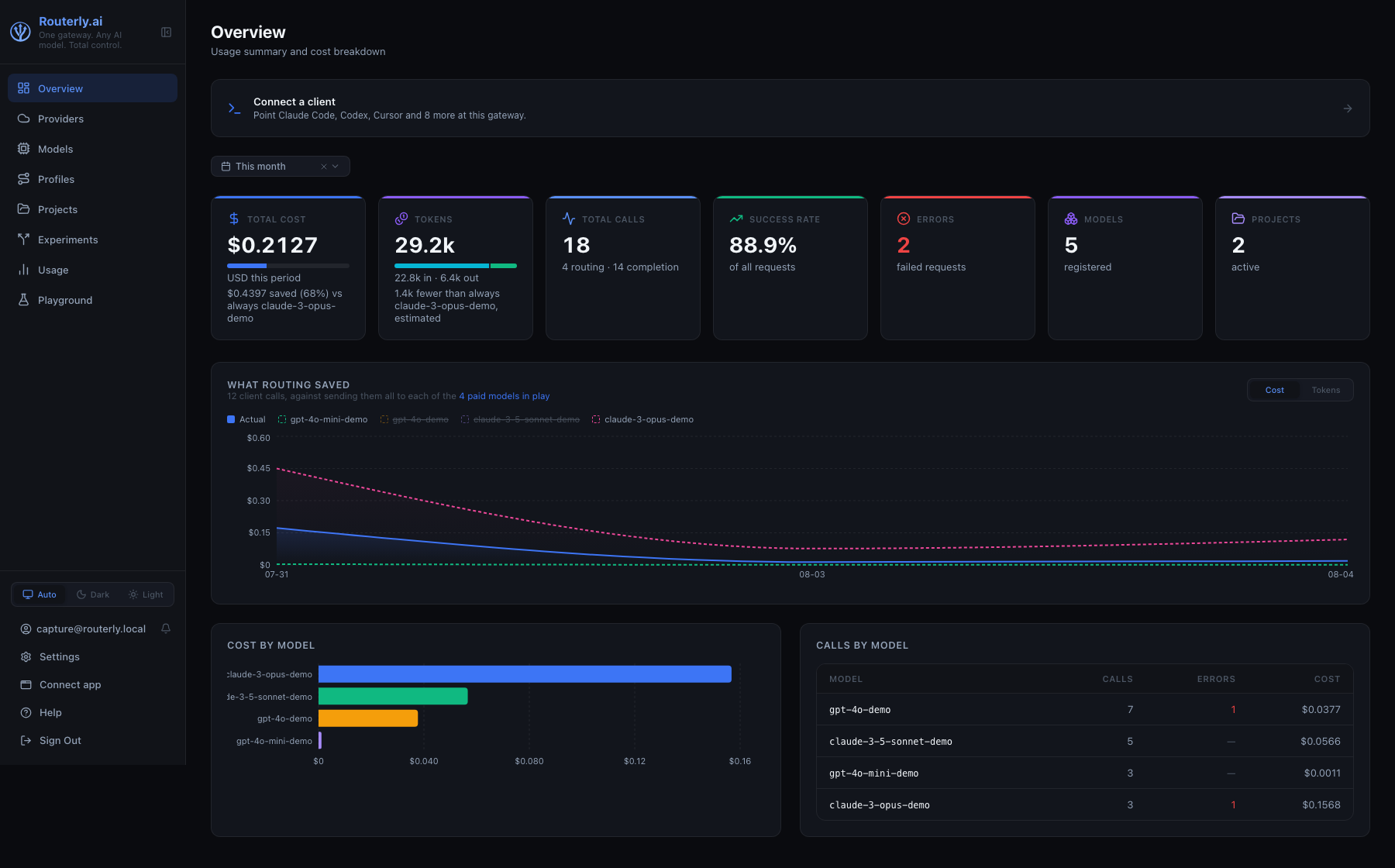
| Explainable decisions | Routing trace per request, Playground with trace and cost breakdown, per-call usage records |
| Budgets and cost tracking | Every call priced per token; hard limits (hourly to yearly, rolling windows) at global, router and token level, enforced before the provider is called |
| Guardrails and PII scrubbing | Rule- and judge-based content guardrails and PII policies on requests, responses, or both |
| 8 token optimizers | session-dedup, ccr, rtk, headroom, json-table, relevance, caveman, llmlingua-2; off by default, enabled per router |
| Experiments | A/B test whole routers against each other with no client change |
| OpenAI + Anthropic compatible | /v1/chat/completions, /v1/responses and /v1/messages |
| Roles and audit | Custom roles over 26 granular permissions, two-factor authentication, audit log |
| Notifications | In-app inbox, email (SMTP, SES, SendGrid, Azure, Google) and webhooks (generic, Slack, Teams, PagerDuty, Discord) |
| MCP server | Personal MCP tokens let Claude Code, Cursor, Cline and other MCP clients inspect and adjust Routerly with your permissions |
| Zero infrastructure | No database, no Redis: configuration lives in JSON files |
| Dashboard, CLI, API | Every function is available in all three |
| Self-updating | Update check against GitHub Releases every 24 h. Channels: latest, current, next, develop. Update from the dashboard or with routerly update run |
How It Works
Point your app — or any AI tool like Cursor, Open WebUI, OpenClaw, or LangChain — at localhost:3000 instead of the provider's URL. From that moment, Routerly takes over: it picks the best available model for each request, enforces your budget, tracks every token spent, and automatically reroutes if a provider fails.
Any Client                 Routerly             Providers
──────────                 ────────             ─────────
Your App   ──▶            Authenticate         OpenAI
Cursor                    Policy scoring  ──▶  Anthropic
Open WebUI  POST /v1/     Select model         Gemini
OpenClaw    chat/         Forward request      Ollama
LangChain   completions   Track cost     ◀──  ...
           ◀──            Return response
- Your app sends a request to Routerly using a router token as the Bearer header
- Routerly authenticates the token and resolves the router
- Enabled routing policies run in parallel and score each candidate model
- The highest-scoring model within budget receives the request
- Response is forwarded back; tokens, cost, and latency are recorded
- On error or timeout, the next candidate is tried automatically
Use Cases
| Scenario | How Routerly helps |
|---|---|
| SaaS & multi-tenant | One router per tenant, hard spend caps, automatic cheapest-model routing |
| Local-first development | Develop against Ollama locally, promote to a hosted model in production — same API, same code |
| Automatic cost reduction | Route simple tasks to cheap models, complex ones to capable models |
| Resilience & failover | Register the same capability across OpenAI, Claude, and Gemini — Routerly detects failures and reroutes in real time |
| AI tools & chat UIs | Cursor, Open WebUI, OpenClaw, LibreChat — any tool that speaks OpenAI or Anthropic format |
| Model evaluation / A/B testing | Run an experiment between routers; compare cost, latency, and error rate in the dashboard |
Quick Start
macOS / Linux:
# Install v0.5.3 (the default channel still resolves to an older release)
curl -fsSL https://www.routerly.ai/install.sh | bash -s -- --version v0.5.3
Windows (PowerShell):
# Install v0.5.3 (the default channel still resolves to an older release)
powershell -c "& ([scriptblock]::Create((irm https://www.routerly.ai/install.ps1))) -Version v0.5.3"
Then create the admin account at http://localhost:3000/dashboard, log in from the CLI, register a model and create a router:
routerly auth login --url http://localhost:3000 --email [email protected]
routerly model add --id gpt-5-mini --provider openai --api-key sk-YOUR_KEY
routerly router create --name "My App"
routerly router model add "My App" gpt-5-mini
Open http://localhost:3000/dashboard to manage everything from the web UI.
→ See the Installation guide and Quick Start tutorial for full details.
Comparison
Last verified: 2026-10-21, against each project's public README and documentation. "n/v" means not verifiable from public documentation.
| Routerly (0.5.x) | LiteLLM proxy | Bifrost | Portkey OSS gateway | OpenRouter | |
|---|---|---|---|---|---|
| Self-hosted | ✅ | ✅ | ✅ | ✅ | ❌ hosted service |
| Open source | AGPL-3.0 | open core, enterprise features under a commercial license | Apache-2.0 (enterprise tier exists) | MIT (hosted/enterprise tier exists) | n/a |
| OpenAI-compatible API | ✅ | ✅ | ✅ | ✅ | ✅ |
Anthropic Messages API (/v1/messages) | ✅ | ✅ | ✅ (/anthropic) | n/v | n/v |
| Database for core use | none (JSON files) | PostgreSQL recommended for production; virtual keys and spend tracking use it | n/v | n/v | n/a |
| Routing | 11 composable policies, profiles, orchestrators | fallback, weighted, latency, cost, usage, least-busy strategies | routing rules, key/provider load balancing, fallbacks | fallbacks, retries, weighted load balancing | n/v |
| LLM- or intent-based routing | ✅ (llm, semantic-intent) | n/v | n/v | n/v | n/v |
| Budgets / spend control | ✅ global, router, token | ✅ spend tracking and limits per key/team/user | ✅ virtual keys, teams, customers | n/v | n/v |
| Guardrails | ✅ built in (rules, judge, PII) | ✅ | enterprise tier | ✅ input/output checks (PII redaction listed as enterprise) | n/v |
| Token optimizers | ✅ 8, opt-in | n/v | n/v | n/v | n/v |
| MCP | management MCP server (not a tool gateway) | MCP gateway | MCP client and server | MCP gateway (separate product) | n/v |
| Roles and permissions | ✅ custom roles, 26 permissions | n/v (SSO listed as enterprise) | enterprise tier | n/v | n/v |
| SSO (OIDC/LDAP) | not yet | enterprise | enterprise | n/v | n/v |
| Web UI | ✅ dashboard | ✅ admin UI | ✅ built-in | local log console | hosted dashboard |
These gateways overlap with Routerly and are not mutually exclusive: anything that speaks the OpenAI or Anthropic API can be registered behind Routerly as a custom provider.